Why Spay or Neuter, and How to Find Low-Cost Spay and Neuter
By Tanika Hall, Founder of Fyndaria. Checked against the AVMA, the Texas A&M College of Veterinary Medicine, the ASPCA and Cats Protection on November 3, 2026.
TL;DR
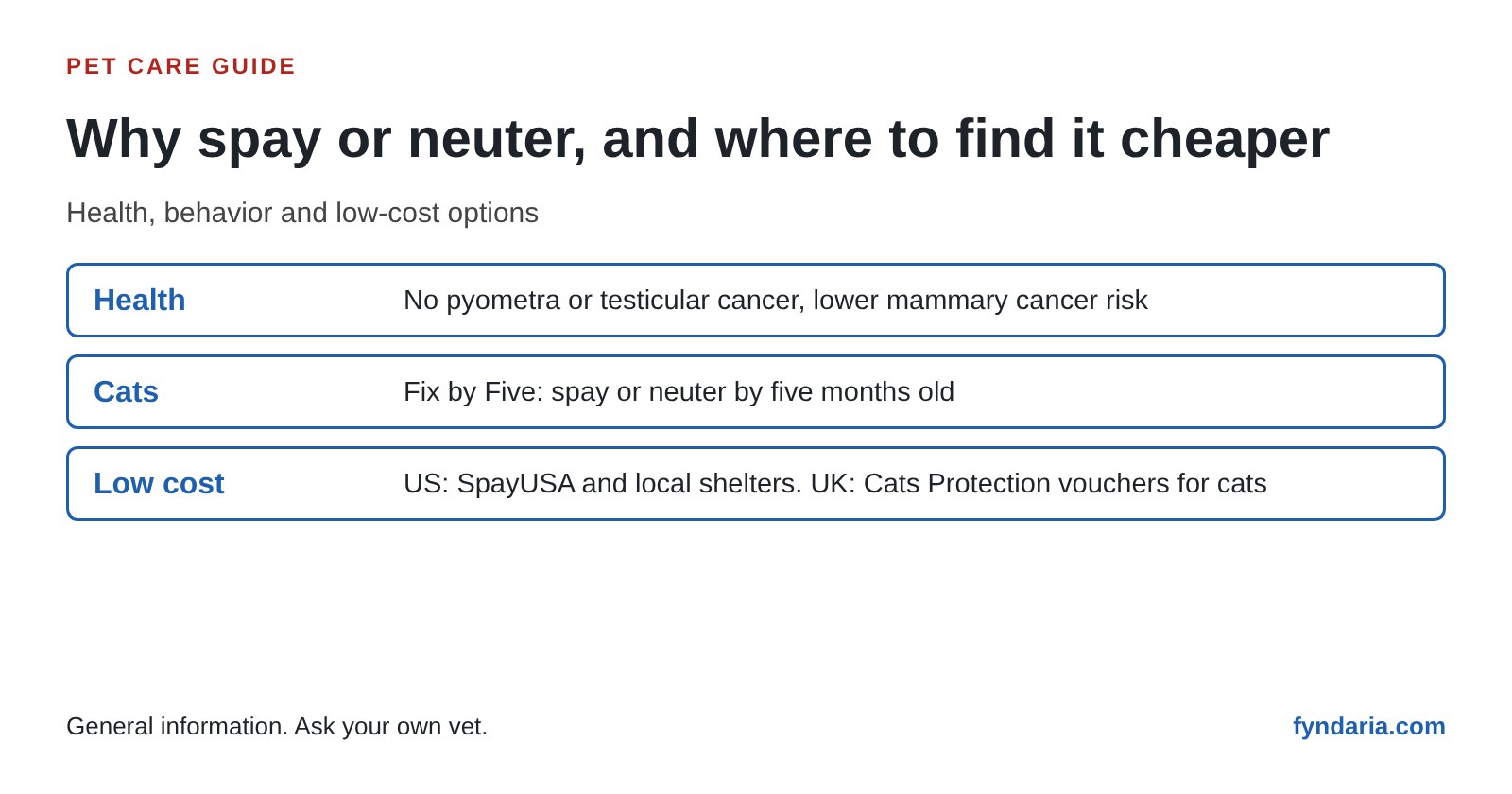
- Spaying a female removes the risk of pyometra, a life-threatening uterine infection, and lowers the risk of mammary (breast) cancer. Neutering a male removes the risk of testicular cancer.
- Neutered males are less likely to roam or mark with urine, and spayed females don't go through heat cycles.
- For cats, vet groups including the AVMA, AAFP and AAHA back the "Fix by Five" recommendation: spay or neuter by five months old, because cats can mature as early as 4 to 5 months.
- For dogs, ask your vet about timing.
- Low-cost options: in the US, start with the SpayUSA database linked from the ASPCA, your local shelter or humane society; in the UK, Cats Protection neutering vouchers for cat owners on lower incomes.
Why spay or neuter
Health
- Pyometra. Spaying eliminates pyometra, a uterine infection in unspayed females that can be life-threatening.
- Mammary cancer. Spaying reduces the risk of breast cancer, the most common cancer in female dogs. In dogs, the benefit is greatest when the spay happens before the first heat.
- Testicular cancer. Neutering removes the risk completely.
Behavior
- Neutered males are less likely to roam, which keeps them away from cars, fights and getting lost.
- Neutering reduces urine marking in males.
- Spayed females don't go into heat, so no yowling cats or dogs in season to manage.
Fewer unplanned litters
One unplanned litter can turn into many. Spaying and neutering is the simplest way to make sure your pet doesn't add to the number of animals waiting in shelters.
After surgery
Texas A&M notes that spaying or neutering reduces a pet's metabolic rate by about 25 percent. Ask your vet whether to adjust how much you feed so your pet doesn't gain weight.
When to do it
Cats: spay or neuter by five months old. This "Fix by Five" recommendation was endorsed by the AVMA in 2017 and is supported by the American Association of Feline Practitioners, the American Animal Hospital Association and the Association of Shelter Veterinarians, among others. Cats can become sexually mature between 4 and 5 months, so a cat could get pregnant before 6 months.
Dogs: ask your vet to recommend a timing for your dog.
How to find a low-cost spay or neuter
In the US
- SpayUSA database. The ASPCA points owners to the SpayUSA database to find low-cost spay and neuter providers in their area.
- ASPCA clinics. The ASPCA runs its own services in New York City, Los Angeles (for qualifying residents) and Western North Carolina.
- Your local shelter or humane society. Many run their own low-cost clinics or vouchers, or know who does.
- Your regular vet. Ask whether they take part in a local low-cost program or offer a payment plan.
In the UK
- Cats Protection vouchers (cats only). Local Cats Protection teams may give neutering vouchers to owners who receive certain means-tested benefits, such as Universal Credit or Pension Credit, or have a household income under £25,000 a year before tax. The voucher covers part of the cost and you pay any balance to the vet. Find your local team on the Cats Protection website.
- London. The C4 Neutering Scheme (c4cats.info) runs separately from the Cats Protection vouchers.
- Your local vet and rescue centers. Ask what schemes are running near you for cats and dogs. Many run campaigns at certain times of year.
What to ask before you book
- What does the price include? Pre-surgery check, pain relief to take home, a cone and a recheck?
- Is pre-anesthetic bloodwork included or extra?
- What age and weight do you need my pet to be?
- Can you microchip at the same time? It is easy to do while your pet is already under anesthesia. See our guide to why to microchip and vaccinate for rabies early.
Common questions
At what age should a cat be spayed or neutered?
By five months old. The "Fix by Five" recommendation is endorsed by the AVMA and supported by feline and shelter vet groups, because cats can mature as early as 4 to 5 months.
Does spaying reduce cancer risk?
Yes. Spaying reduces the risk of mammary cancer and eliminates pyometra, and neutering eliminates the risk of testicular cancer. In dogs, spaying before the first heat gives the greatest benefit against breast cancer.
How can I find a cheap spay or neuter near me?
In the US, search the SpayUSA database linked from the ASPCA's low-cost spay and neuter page, and call your local shelter or humane society. In the UK, cat owners can ask their local Cats Protection team about neutering vouchers if you receive certain benefits or have a household income under £25,000.
Will neutering stop my male cat or dog from marking?
It reduces urine marking in males, and neutered males are less likely to roam. Habits that are already established may not stop completely, so talk to your vet if marking continues.
Thinking about moving abroad with your pet?
Some countries ask about spay and neuter status, and every move starts with the right microchip and vaccine records. Start with a free Pet Travel Assessment at fyndaria.com/travel-concierge, or from the UK at fyndaria.com/uk/travel-concierge-intake.
Sources: Texas A&M College of Veterinary Medicine: Spaying and neutering pets · AVMA JAVMA News: Fix by Five campaign · ASPCA: Low-cost spay/neuter programs · Cats Protection: Neutering support. This article is general information, not veterinary advice. Ask your own vet about your pet.