Rabies Vaccine and Microchip: Why to Do Both Early
By Tanika Hall, Founder of Fyndaria. Checked against the national rabies compendium, the UK government and USDA APHIS on November 3, 2026.
TL;DR
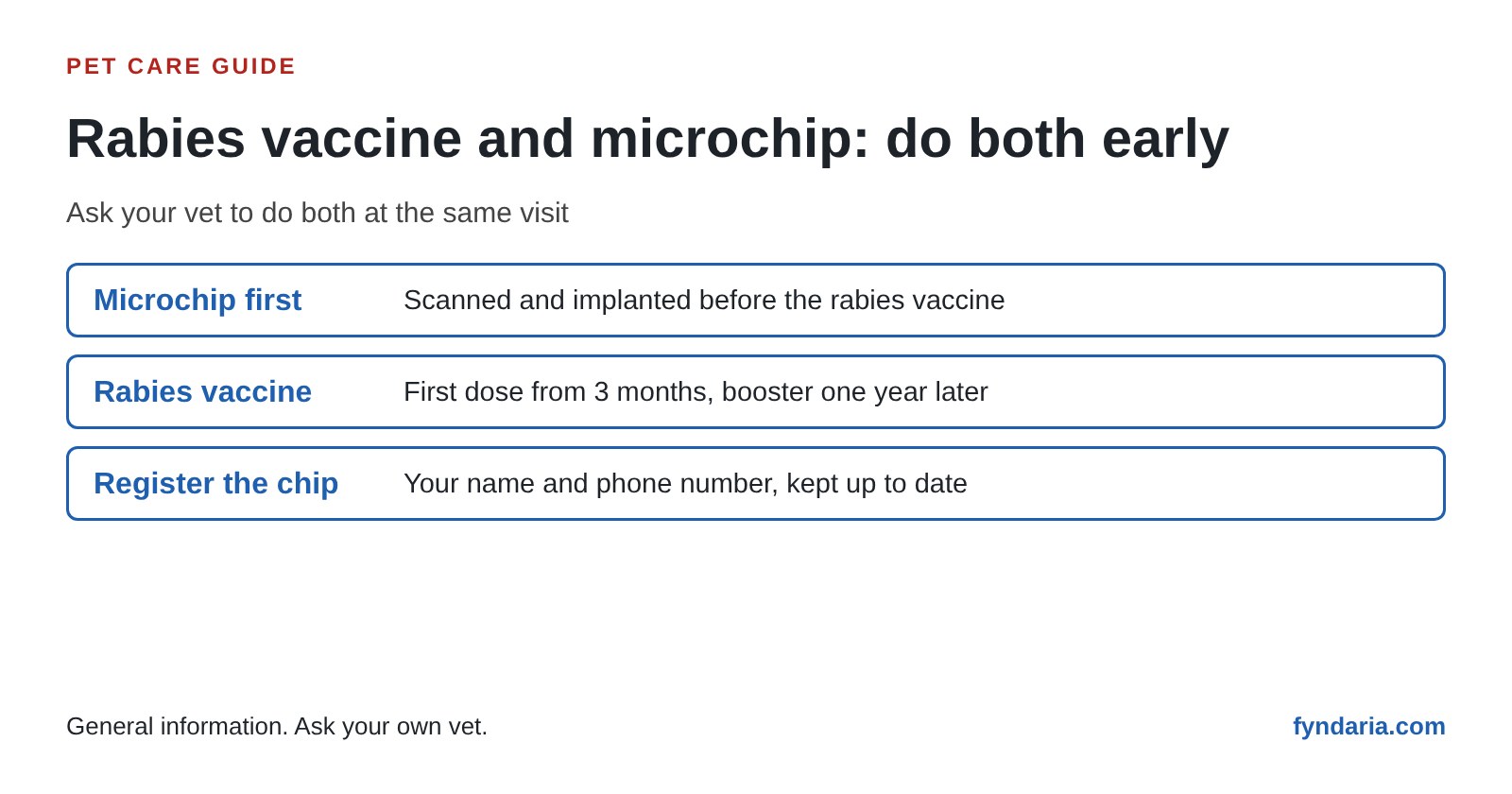
- When your vet suggests the rabies vaccine and a microchip, say yes and do both at the same visit if you can.
- The national rabies compendium says all dogs, cats and ferrets should be vaccinated against rabies, with the first dose no earlier than 3 months old for most vaccines and a booster one year later.
- Indoor cats need it too. The 2011 national rabies compendium reported more rabies cases in cats than in dogs.
- Microchipped pets are far more likely to get home. In one study of 53 US shelters, microchipped cats were 20 times more likely and dogs 2.5 times more likely to be returned to their owners.
- Order matters if you will ever travel abroad. For the EU, USDA APHIS says the chip must be in and scanned before the rabies vaccine. Chip first, then vaccine, works for the EU and the UK.
Why the rabies vaccine should not wait
The national rabies compendium says rabies has one of the highest case-fatality ratios of any infectious disease. The vaccine is how you keep it from ever reaching your home. The national Compendium of Animal Rabies Prevention and Control says all dogs, cats and ferrets should be vaccinated, with the first dose no earlier than 3 months of age for most vaccines and a booster one year later, whatever age the first dose was given.
Many states and counties may also require it by law, especially for dogs, and you will usually need proof of vaccination for a license, boarding, grooming or daycare. Your vet will know the rules where you live.
"My cat never goes outside"
This is the most common reason people put it off. The 2011 compendium reported more rabies cases in cats than in dogs, and it says cat vaccination should be required. Bats get into houses, and an indoor cat can slip out. If a pet is exposed to rabies, the rules for what happens next are much stricter for an unvaccinated pet than for a vaccinated one.
Why microchip early
Collars come off. A microchip is a tiny permanent ID under the skin that most shelters and vets can scan. A study published in the Journal of the American Veterinary Medical Association in 2009 tracked stray animals at 53 shelters in 23 states. Microchipped cats were about 20 times more likely, and microchipped dogs about 2.5 times more likely, to be returned to their owners than strays overall.
The chip only works if it is registered. After the vet implants it, register it in your name and update your phone number and address every time they change. An unregistered chip leads a shelter nowhere.
It is the law in England
Since June 10, 2024, cats in England must be microchipped before they reach 20 weeks old, and owners who don't comply can face a fine of up to £500. Microchipping was already compulsory for dogs.
Why the order matters for travel
If there is any chance your pet will travel internationally, the microchip has to come first. The UK government says your pet must be microchipped before or at the same time as its rabies vaccination, or it will need to be vaccinated again. USDA APHIS is stricter for pets going from the US to EU countries such as Italy: the pet needs a working microchip before the rabies vaccine, and the vet must scan the chip before vaccinating. At one visit, that means chip first, then vaccine. A vaccine given before the chip does not count.
Getting this wrong can delay a move by weeks. A new rabies vaccine can mean waiting at least 21 days before an EU trip, and some countries also require a blood test, which adds more time. Doing the chip and the rabies vaccine together, chip first, avoids all of it.
What to ask at the appointment
- Can you scan for a chip first, implant one if there isn't one and then give the rabies vaccine at the same visit?
- Is the chip an ISO 11784/11785 chip (usually 15 digits)? With other chips you may need to carry your own reader when you travel.
- Which rabies vaccine are you using, and is it a 1-year or 3-year vaccine?
- Can I have the vaccine certificate with the microchip number, date and vaccine details on it?
- When is the booster due?
Keep the certificate with your pet's records. If you travel, that one page is the document every country asks for first.
Common questions
When should a puppy or kitten get the rabies vaccine?
The national rabies compendium lists 3 months as the minimum age for the first dose of most vaccines for dogs, cats and ferrets, with a booster one year later. Your vet will confirm the timing for the vaccine they use.
Do indoor cats need a rabies vaccine?
Yes. The compendium says all cats should be vaccinated, and its 2011 edition reported more rabies cases in cats than in dogs. Bats can get indoors and indoor cats can escape.
Does the microchip have to go in before the rabies vaccine?
For travel, yes. The UK accepts a chip implanted before or at the same visit as the rabies vaccine. For the EU, USDA APHIS says the chip must be in and scanned before the vaccine. If the order is wrong, the vaccine has to be given again.
Do microchips really help lost pets get home?
Yes. In a 2009 study of 53 US shelters, microchipped cats were about 20 times more likely and dogs about 2.5 times more likely to be returned to their owners. The chip has to be registered with your current details.
Planning to travel with your pet?
Fyndaria checks your pet's microchip and vaccine records against your destination's rules before anything is booked. Start with a free Pet Travel Assessment at fyndaria.com/travel-concierge, or from the UK at fyndaria.com/uk/travel-concierge-intake.
Sources: CDC MMWR: Compendium of Animal Rabies Prevention and Control, 2011 · The Ohio State University: Microchips result in higher rate of return of shelter animals to owners (JAVMA, 2009) · GOV.UK: Cat microchipping now mandatory · GOV.UK: Taking your pet abroad, microchip · USDA APHIS: Pet travel from the US to Italy. This article is general information, not veterinary advice. Ask your own vet about your pet.