How to Get Your Pet Used to a Travel Crate Before a Flight
By Tanika Hall, Founder of Fyndaria. A 14 day plan for dogs and cats, with a crate setup checklist, what goes in the crate, the US 4 hour food and water rule and why not to sedate. Checked against IATA, IPATA, the AVMA, the AAFP, USDA rules and airline policies on October 30, 2026.
TL;DR
- Buy the crate at least two weeks before the flight. The AVMA, IPATA and the Army Public Health Center all say the same thing: the day of travel should not be the first time your pet sees it.
- Start with the door open and treats inside. Work up to naps with the door closed, then short car rides in the crate.
- US rules require that your pet was offered food and water in the 4 hours before you hand it to the airline, and that you certify it in writing on the crate. Keep the meal light. Water right up to handover.
- No sedatives or tranquilizers. IATA does not encourage them, the AVMA warns they raise heart and breathing risks, and American Airlines will not accept a sedated dog or cat.
- Two dishes clipped inside the door, absorbent bedding under 3 inches, no straw, no battery-powered anything. Keep the ID tag on the pet.
- Shopping list: metal nuts and bolts, zip ties for the door, an absorbent pad, clip-on food and water dishes, "Live Animal" and "This Way Up" labels and a document pouch. The full checklist is below.
Why this matters
A pet that has only ever seen the crate at the airport will panic in it. A pet that has slept in it for two weeks treats it as a den. Airline staff look at your pet at drop-off, and a frantic animal makes for a bad flight and a hard landing. The crate itself has to fit first. If you have not sized it yet, read how to measure your pet for a travel crate and how to choose an IATA-compliant crate before you start.
Crate setup checklist: what to buy
Get these the day you buy the crate so you can practice with the crate set up the way it will fly. Each item comes from the IATA container rules or airline kennel rules listed in the sources.
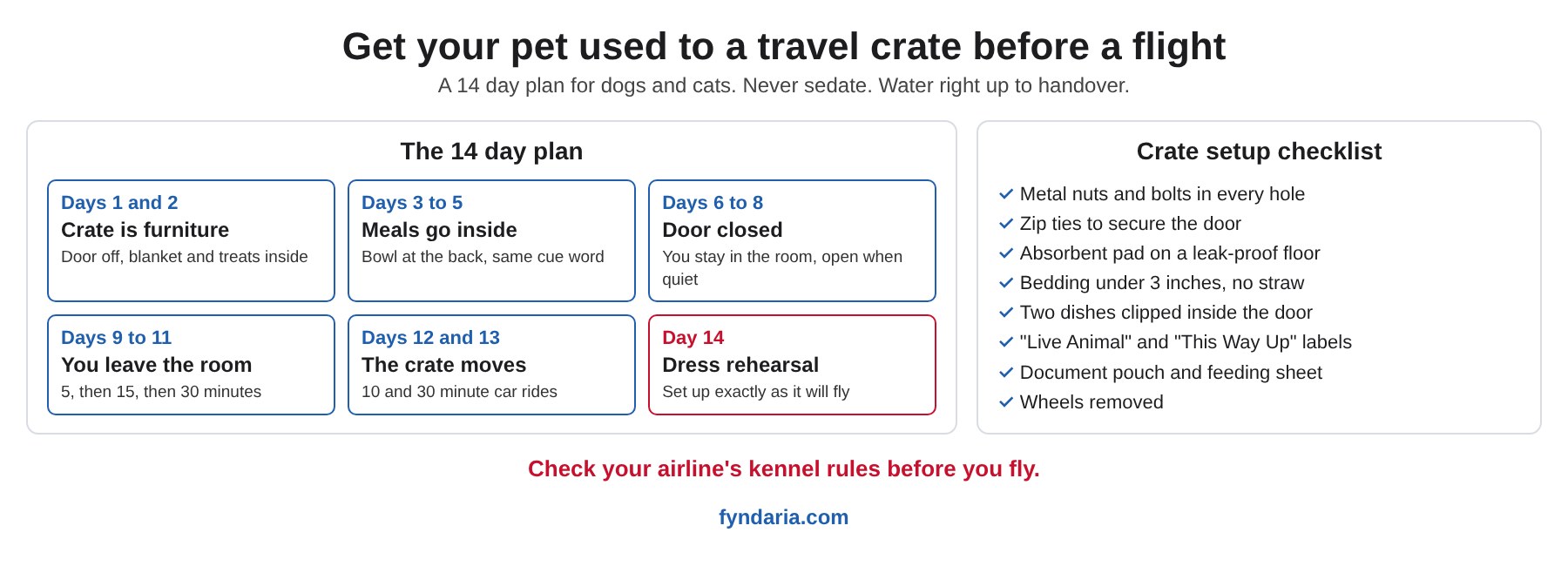
- Metal nuts and bolts: Plastic clips must not be the only thing holding the top and bottom halves together. IATA recommends metal nuts and bolts in every hole. Most airline crates come with them; check that none are missing.
- Zip ties (cable ties): IATA says the door of a rigid plastic crate should be further secured with removable fasteners such as cable ties. Thread them through the door and the crate frame so the door cannot open. Zip ties are an extra lock, never a repair: Alaska Air Cargo will not accept a crate that has parts replaced by zip ties, duct tape or rubber bands.
- Absorbent pad: IATA requires a solid, leak-proof floor and absorbent bedding, and US rules require enough absorbent material to soak up accidents. Lay a puppy pad or other absorbent liner flat on the floor.
- Bedding under 3 inches: A blanket, towel or thin flat bed on top of the pad. American Airlines wants bedding under 3 inches high and bans hay, straw and wood shavings.
- Two clip-on dishes: One for food, one for water, clipped inside the door so they do not tip or slide. IATA requires the water container to be fixed inside the crate and fillable from outside without opening the door. Loose bowls spill; bottles hung on the outside are not allowed.
- "Live Animal" labels and "This Way Up" arrows: IATA makes both mandatory, with the arrows on at least two opposite sides. Alaska Air Cargo asks for "Live Animal" in letters at least 1 inch high.
- Document pouch: Attached securely to the crate. It holds the 4 hour food and water statement, the 24 hour feeding sheet and copies of your pet's papers.
- Packing tape and a small food bag: To tape a bag of food and the leash to the top of the crate for delays and pickup.
- Marker or printed labels for ID: Your name, address and phone number on the crate, matching the tag on your pet.
If the crate has wheels, take them off. IATA says wheels must be removed or made unusable, and Alaska Air Cargo will not accept a crate until they are off.
The 14 day plan
The steps below are the ones veterinary behavior guidance uses for crate and carrier training: door open first, meals inside, then the door closed for longer and longer, then you out of the room, and never opening the door while the pet is crying. Two weeks is enough for most pets that have never used a crate. UC Davis veterinary school notes the time varies from animal to animal, so if your pet is not ready, stretch the plan rather than rush it. A dog that already sleeps in a crate can start at day 6.
- Days 1 and 2: The crate is furniture. Put the crate in the room where your pet spends the most time. Take the door off or tie it fully open so it cannot swing shut. Put a blanket from their bed inside, or a shirt that smells like you; the AAFP says bedding or clothing with your scent helps a cat feel secure. Drop a few treats just inside and walk away. Never push, lift or chase them in.
- Days 3 to 5: Meals go inside. Feed every meal in the crate, bowl at the back. Most dogs are all the way in by day 3. For a cat, start with the bowl at the opening and move it back a few inches each meal. Say the same word each time they go in so it becomes a cue.
- Days 6 to 8: Door closed, you in the room. Put the door back on. Close it while they eat, then open it before they finish. Add a minute each time. Sit nearby and ignore them. If they cry, wait for a quiet moment before opening, so quiet is what earns the exit. If the crying does not stop, go back to a length they handled well and build more slowly.
- Days 9 to 11: Door closed, you out of the room. Close the door after a meal or a treat and leave the room for 5 minutes, then 15, then 30. Come back before they get upset. By day 11 most pets will nap in the crate with the door shut while you are elsewhere in the house.
- Days 12 and 13: The crate moves. Carry the crate with your pet inside across the room, then out to the car. Belt the crate in so it does not slide. Take a 10 minute drive, then a 30 minute drive. The Army Public Health Center recommends these short trips so the pet gets used to motion and so you learn now whether it gets car sick. If it does, tell your vet now.
- Day 14: Dress rehearsal. Set the crate up exactly as it will fly: bedding, dishes clipped inside the door, your contact details on the crate, the feeding sheet in its pouch. Put your pet in, close the door, drive somewhere and sit in the parked car for 20 minutes. Then home, door open, a lot of praise.
What goes in the crate
- Absorbent bedding. US animal welfare rules require enough absorbent material to soak up accidents, and airlines check for it. A blanket, towel or flat bed is fine. American Airlines allows blankets, towels and beds, bans hay, straw and wood shavings, and wants bedding under 3 inches high so it cannot block the vents. A puppy pad under the blanket is a good base.
- Something that smells like you. A worn t-shirt. Do not wash it first.
- Two dishes clipped inside the door, one for food and one for water, reachable from outside without opening the door. That is the airline standard and USDA guidance. Bottle feeders and anything hung on the outside are not allowed. Many shippers freeze the water the night before so it melts slowly instead of spilling at drop-off; practice with the frozen bowl at home so your pet knows to drink from it.
- A small bag of food taped to the top for delays, plus a sheet in the crate pouch saying when the pet last ate and drank and how to feed and water it for the next 24 hours. US rules require that sheet and airlines will ask for it.
- Nothing that can be chewed apart or run on a battery. No rope toys, rawhide or stuffed toys. No heated pads. One hard chew toy is fine for a dog that will not destroy it.
- ID on the pet and on the crate. IPATA's advice is to write your name, address and phone number on the kennel and keep a tag with the same details on the pet. Leave the leash out of the crate so it cannot snag; tape it to the top so it is there at pickup. Ask your airline whether it wants the collar off or a breakaway collar for the flight.
Food and water: the 4 hour rule
This one is law in the US, not a tip. Under USDA animal welfare rules, a dog or cat must be offered food and water during the 4 hours before it is handed to the airline, and you must certify that in writing on the crate, with the time of the last feeding and watering and instructions for the next 24 hours. American Airlines and Delta both check for that statement at drop-off.
How big that meal should be is where the guidance differs, so here is the range.
- USDA (9 CFR 3.14): Offered food and water within the 4 hours before delivery to the carrier; certified in writing on the crate with 24 hour instructions
- IATA: A light meal and a small drink about two hours before dispatch; water right up to the time of travel
- IPATA: No solid food in the six hours before the flight; a moderate amount of water and a walk before and after
- AVMA: Ask your veterinarian whether and when to feed before, during and after air travel
Our practice: a small meal inside the 4 hour window so the certification is true, no big meal, and water until handover. If your pet got car sick during the practice drives, ask your vet before the flight.
Do not sedate your pet
IATA says it does not encourage sedatives or tranquilizers for animals being transported, and notes the American Veterinary Medical Association takes the same view. The AVMA's own guidance says these drugs can increase the risk of heart or breathing problems and generally are not allowed by airlines. Delta says the effect of tranquilizers at altitude is unpredictable and requires written consent from your vet if you use one. American Airlines will not accept a household dog or cat that has been sedated or tranquilized. IPATA puts it in three words: never sedate your pet.
If your pet is truly anxious, ask your vet about non-sedating options. The AAFP suggests a synthetic feline pheromone spray in the carrier at least 30 minutes before a trip, and the Army Public Health Center lists pheromone products as a way to reduce travel stress for dogs and cats. Start any product during the 14 day plan, not on the day.
Signs your pet is ready
- Walks into the crate on the cue word without a treat.
- Lies down and settles within a few minutes of the door closing.
- Rides 30 minutes in the car without drooling, panting hard or crying the whole way.
- Drinks from the clipped bowl.
If any of these are missing a week out, stretch the plan. A few extra days at home are cheaper than a bad flight.
Common questions
How long does it take to crate train a dog for a flight?
About two weeks for most dogs that have never used a crate, and about a week for a dog that already sleeps in one. Cats usually need the full two weeks and do best when the carrier stays out as furniture the whole time. Veterinary guidance says the time varies, so go by your pet, not the calendar.
Can I give my dog Benadryl or a sedative for the flight?
Not without your vet. IATA does not encourage sedatives or tranquilizers for air travel, the AVMA says they raise heart and breathing risks, and American Airlines will not accept a sedated dog or cat. Ask your vet about non-sedating options and start them during the practice period.
Should I feed my dog before a flight?
Yes, lightly. US rules require that the pet was offered food and water in the 4 hours before handover, and you certify it on the crate. IATA suggests a light meal about two hours before. Keep it small and keep offering water until you hand the pet over.
Do I need zip ties on my pet's crate?
For a rigid plastic crate, yes. IATA says the door should be further secured with removable fasteners such as cable ties, so thread them through the door and the crate frame. Use them only as an extra lock. A crate with missing parts held on by zip ties can be refused, and plastic clips alone should not hold the two halves together; use the metal nuts and bolts.
What should I put in my pet's crate for the flight?
Absorbent bedding under 3 inches with no straw or shavings, something that smells like you, two dishes clipped inside the door, a bag of food taped to the top and the feeding sheet in the pouch. No loose toys that can be chewed apart, nothing battery powered, and no leash inside.
My cat will not go in the crate at all. What now?
Take the door off, put the carrier where the cat already sleeps, add bedding that smells like you, and feed every meal a little farther inside each day. Never chase or force the cat in. The AAFP notes treats left in the carrier often start disappearing overnight before the cat is ever seen using it. Most cats are sleeping in it within a week once it stops being a trap.
Related guides
Need a crate sized and a plan for the whole move? Start with a free Pet Travel Assessment at fyndaria.com/travel-concierge.
Sources: IATA: Traveling with pets · IATA: Pet container requirements · Alaska Air Cargo: Kennel requirements · IPATA: Pet travel tips · AVMA: Traveling with your pet · AAFP: Getting your cat to the veterinarian · UC Davis School of Veterinary Medicine: Crate training your puppy · US Army Public Health Center: Travel crates · USDA APHIS: Preparing and receiving pets for air travel · 9 CFR 3.14 · 9 CFR 3.15 · American Airlines Cargo: Day of travel · American Airlines Cargo: Kennel requirements · Delta: Pet requirements and restrictions. All pages opened October 30, 2026. Airline rules change; check your airline's current page before you fly.