How to Measure Your Pet for a Travel Crate
By Tanika Hall, Founder of Fyndaria. Rules checked against official sources on October 27, 2026.
TL;DR
- Take four measurements of your pet while it stands: body length, leg height, width and full standing height.
- Then use the formula from IATA (the International Air Transport Association) to get the smallest inside size the crate can have.
- Your pet must be able to stand, sit up straight, turn around and lie down in a natural way.
- If the crate is too small, the airline can refuse your pet at drop-off.
Last updated: October 27, 2026.
Why the size matters
Airlines check the crate at drop-off. American Airlines Cargo says that if any kennel rule is not met, the pet cannot fly on the booked flight and must be rebooked, which can cost more. US federal rules also say each dog or cat must have room to turn around while standing, to stand and sit up straight and to lie in a natural position.
This guide covers size only. To pick a crate that is built right (doors, vents, bolts), read how to choose an IATA-compliant crate. Not sure your pet will fly in cargo at all? Start with cabin, checked or cargo.
What you need
A soft tape measure, a helper, a few treats and a notepad. Measure in inches or centimeters, but use the same unit the whole time.
Step by step
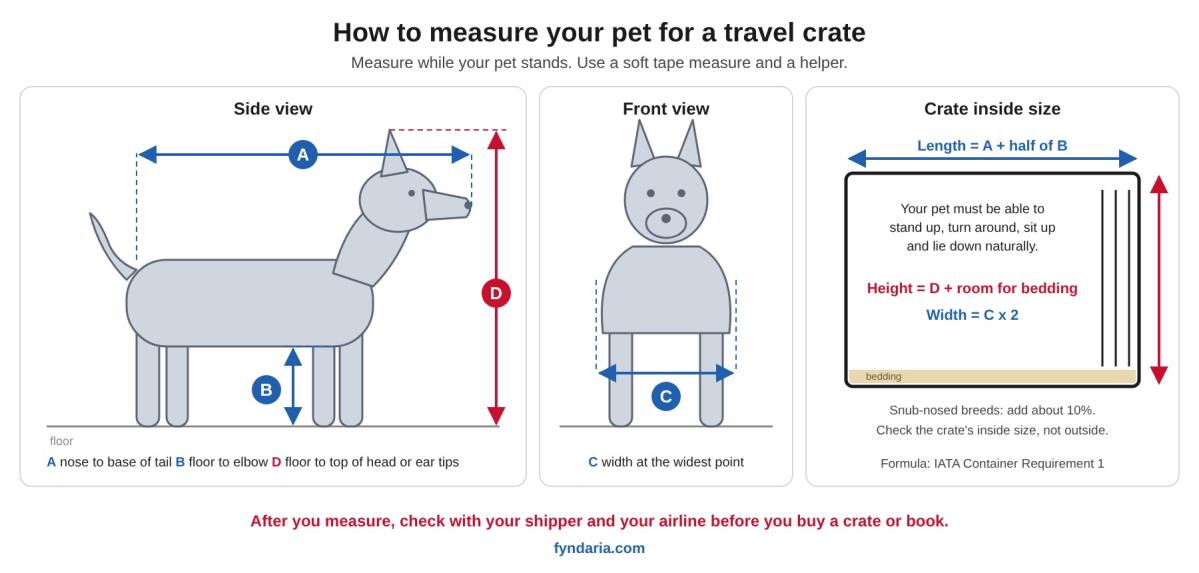
- Get your pet standing. Your pet should stand on all four legs on a flat floor, head up in its normal pose. Do not measure while it lies down or stretches. American Airlines Cargo says to measure the animal as it would stand in the kennel.
- Measure A: body length. Go from the tip of the nose to the base of the tail. Do not include the tail.
- Measure B: leg height. Go from the floor up to the elbow joint of the front leg.
- Measure C: width. Go across the shoulders or the widest part of the body, whichever is wider.
- Measure D: standing height. Go from the floor to the top of the head or the tip of the ears, whichever is higher. If the ears stand up, measure to the ear tips.
- Use the formula. Plug your numbers into the table below. These are the smallest inside sizes the crate can have.
- Compare to the inside size of the crate. Crate makers often list the outside size. The inside is smaller because of the walls. Check the inside size before you buy.
The formula (IATA Container Requirement 1)
| Crate inside size | Formula | What it means |
|---|---|---|
| Length | A + ½ B | Body length plus half the leg height |
| Width | C × 2 | Twice the width of your pet |
| Height | D | Standing height, plus room for bedding |
| Snub-nosed breeds | About 10% larger | IATA asks for extra room for flat-faced pets |
If two pets share one crate, IATA sets the width at C × 3. For three pets it is C × 4. Many airlines limit sharing, so check first. American Airlines Cargo, for example, allows only young pets of a small weight to share.
American Airlines Cargo uses the same formula: length is A plus half of B, width is C times 2 and height is D. If an airline you fly ever lists a different formula, that airline's own rule applies on its flights. IATA's formula is the general standard.
Find your crate size
Most airline crates are sold in numbered series. Use this table to find the series closest to your numbers. These are the outside sizes Delta Cargo lists for each series. The inside is smaller, so check the maker's inside size against your formula result.
| Crate name | Series | Outside size (in) | Outside size (cm) | Usually fits |
|---|---|---|---|---|
| Small | 100 | 21 × 16 × 15 | 53 × 41 × 38 | Cats and toy dogs |
| Medium | 200 | 27 × 20 × 19 | 69 × 51 × 48 | Larger cats and small dogs |
| Intermediate | 300 | 32 × 22 × 23 | 81 × 56 × 58 | Small to medium dogs |
| Large | 400 | 36 × 24 × 26 | 91 × 61 × 66 | Medium dogs |
| Extra Large | 500 | 40 × 27 × 30 | 102 × 69 × 76 | Large dogs |
| Giant | 700 | 48 × 32 × 35 | 122 × 81 × 89 | Very large dogs |
How to use it: Take your inside length, width and height from the formula. Pick the smallest series where the inside size is bigger than all three numbers. The "Usually fits" column is only a starting point. Your measurements decide, not your pet's breed or weight.
In the worked example below, the dog needs about 29 × 16 × 22 inches inside. The 300 series is only 23 inches tall on the outside, so it is too short once you take off the walls. That dog would most likely need a 400 series. Check the inside size to be sure.
Big crates do not fit every plane. American Airlines Cargo says some smaller aircraft, like the Boeing 737, CRJ and Embraer jets, take only the 100 to 400 series. The Airbus A319 and A320 take no live animals in the hold. Delta limits personal pets to the 300 series or smaller, with some exceptions. If your pet needs a 500 or 700 series crate, confirm the aircraft before you book.
Before you buy or book: These sizes are a guide only. After you measure your pet, check with your shipper and your airline. Crate rules and aircraft limits change and differ by airline. Your pet must be able to stand up without its head or ear tips touching the top, turn around, sit up and lie down in a natural position inside the crate. If it cannot do all of these, the airline can refuse the crate on the day you fly.
A worked example
Say you measure a medium dog with upright ears:
- A (nose to base of tail): 24 inches
- B (floor to elbow): 10 inches
- C (widest point): 8 inches
- D (floor to ear tips): 22 inches
Now do the math:
- Length: 24 + 5 (half of 10) = 29 inches inside
- Width: 8 × 2 = 16 inches inside
- Height: 22 inches inside, plus room for the bedding
So this dog needs a crate that is at least 29 by 16 by 22 inches on the inside, with a little more height for the bed. If this dog were a snub-nosed breed, you would add about 10% to each number. Rounded up, that makes it about 32 by 18 by 25 inches inside.
Common mistakes
Ears left out. Height must reach the tip of the ears if they are higher than the head. American Airlines Cargo says the ear tips must not touch the kennel. Pets with tall, upright ears are easy to size too short.
Sitting height instead of standing height. Measure D while your pet stands. Your pet also has to sit up straight in the crate, so a crate that only fits a lying pet is too small.
Forgetting the bedding. IATA says height is D plus bedding. American Airlines Cargo allows bedding up to 3 inches high. Leave room for it.
Snub-nosed breeds sized like other dogs. IATA asks for a crate about 10% larger for flat-faced breeds. Some airlines will not carry these breeds at all, so check the airline before you buy. Our cargo hold guide covers breed limits.
Measuring a pet that is still growing. If your puppy or kitten will travel in a few months, measure again close to the trip.
Buying by the label. "Large" or "IATA approved" on the box does not prove fit. IATA says it does not certify or approve any pet container. Your numbers decide the size.
Using the outside size. The formula gives inside sizes. Always check the inside.
Quick check before you buy
- Pet measured standing, with a helper
- Ear tips included in height
- Formula done for length, width and height
- Bedding space added to height
- About 10% added for a snub-nosed breed
- Inside size of the crate checked, not outside
- Airline crate size limits checked for your aircraft
- No part of your pet is taller or longer than the crate when it stands next to it
Common questions
How much room should a dog have in a crate for a flight? Enough to stand, sit up straight, turn around and lie down in a natural way. Use the formula: length A + ½ B, width C × 2, height D.
Do the ears have to fit in the crate? Yes. Height goes to the top of the head or the ear tips, whichever is higher. American Airlines Cargo says the ears must not touch the kennel.
Is a bigger crate always better? No. Bigger crates can be too large for some aircraft. American Airlines Cargo lists height limits by plane type, and its largest kennels fly only on certain services. Fit the pet first, then check the airline.
More pet travel guides
- Moving to Japan with a dog or cat
- Taking your dog or cat from the US to the UK
- Taking your dog or cat to Mexico
- Taking your dog or cat to Canada
- How to choose an IATA-compliant crate
Not sure your crate is right or which airline will take your pet? Fyndaria checks your measurements and airline rules as part of every Travel Concierge plan. Start with a free Pet Travel Assessment →
Sources
- IATA: Pet container requirements
- IATA: How to select the correct container
- IATA: Traveling with pets
- American Airlines Cargo: Kennel guidelines
- American Airlines Cargo: Kennel construction requirements
- eCFR: 9 CFR Part 3 Subpart A
- Delta Cargo: Aircraft crate compatibility
- American Airlines Cargo: Aircraft compatibility