CMA Rules on Vet Complaints, Estimates and Prescriptions
By Tanika Hall, Founder of Fyndaria. Checked against Articles 11 to 23 of the Veterinary Services Market Investigation Order 2026 and the CMA's guidance for small veterinary businesses on 3 November 2026. This is a plain English guide, not legal advice.
TL;DR
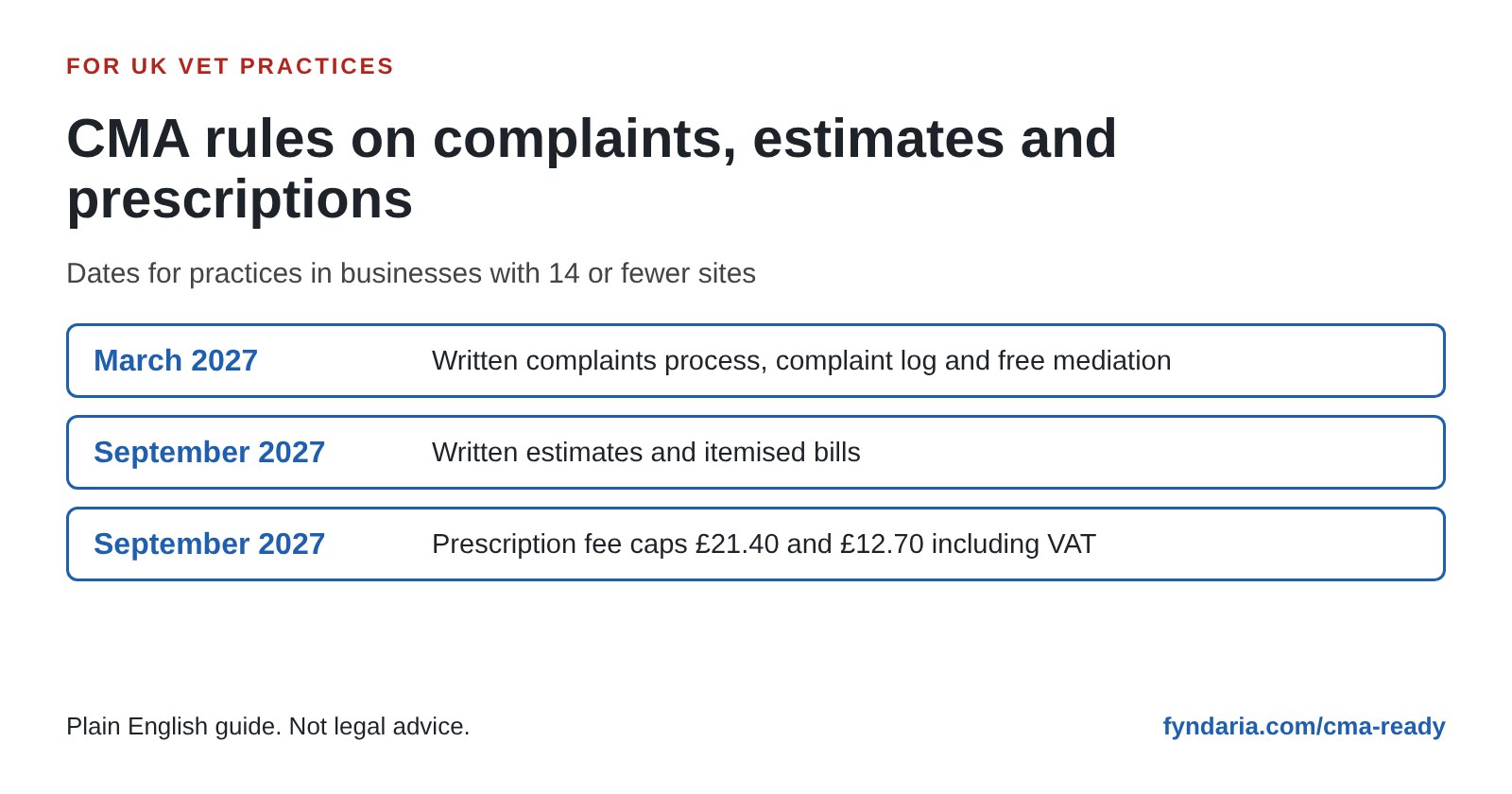
- Complaints: from the next working day after 22 March 2027, every practice needs a written in-house complaints process, a complaint log and a willingness to go to free mediation. This date is the same for large and small businesses.
- Written estimates: from the next working day after 22 September 2027 for small businesses, owners get a written estimate when treatment is reasonably likely to cost £500 or more including VAT, with more than £100 of that for treatment still to come.
- Itemised bills: from the same date, an itemised bill before or when payment is asked for, with medicines shown separately.
- Prescriptions: from the same date, owners must be told they can have a written prescription, and prescription fees are capped at £21.40 for the first medicine and £12.70 for each additional one, including VAT.
Complaints: due March 2027 for everyone
Articles 21 to 23 of the Order set out how complaints must be handled. Unlike most of the Order, small businesses get no extra time here.
- A written in-house process for each practice and out of hours centre, published on your website.
- Ten working days to sort it informally. If a complaint is not resolved within ten working days, it becomes an actionable complaint.
- Acknowledge in writing within five working days once it is actionable.
- A full response within eight weeks of it becoming actionable. You can take longer only by telling the owner in writing within that time, and the full response is still due within 12 weeks.
- The complaints decision tree displayed prominently in reception and on your website. The CMA's guidance says the RCVS will provide the decision tree by 22 January 2027.
- Mediation. Take part in good faith when the Order's criteria are met. The mediation service must be free for pet owners.
- A complaint log, kept for at least 12 months after each actionable complaint is resolved. The CMA has published a template (Schedule 4).
Written estimates: September 2027 for small practices
- Give a written estimate when the treatment recommended is reasonably likely to cost £500 or more including VAT, with more than £100 of that for treatment still to come. £500 is the starting threshold in the Order.
- Give it no later than the end of the working day after the treatment was recommended.
- Break down the separately priced parts of treatment given at your practice, and include the likely cost of any referral with a note to confirm the price with that provider.
- Give an updated estimate if the cost is likely to rise by 20% or by £500, whichever is lower.
Itemised bills: September 2027 for small practices
- Give an itemised bill for every service you charge for, before or at the same time as you ask for payment.
- Show each medicine sold separately, and show other goods and services, including cremation add-ons, separately too.
- For fixed price bundles, show the total, the main parts and the standalone price of any part you also sell on its own.
- For euthanasia and cremation you can give less detail to avoid distress, but add-ons must always be shown.
Written prescriptions and fees: September 2027 for small practices
- Tell owners they can have a written prescription. The Order includes a standard written prescription notice (Schedule 2) and a standard flyer for ongoing medication (Schedule 3). The CMA's guidance says the RCVS will provide its flyer by the end of May 2027.
- Own brand medicines. When you prescribe an own brand medicine, tell owners that the reference product alternative can be bought from third parties.
- Fee caps. £21.40 including VAT for the first medicine in a consultation and £12.70 for each additional medicine. The same caps apply to medicine prescribed outside a consultation. From 1 April 2028 the caps are adjusted each year.
- Same duration either way. How long a prescription lasts must not depend on whether the owner buys the medicine from you or elsewhere. Controlled drugs are excluded from this rule.
Large businesses with 15 or more practices have earlier dates: the next working day after 22 March 2027 for prescription fees and the next working day after 22 June 2027 for estimates, itemised bills and the other prescription rules.
What to change in your practice software
Most of the September 2027 work lands in your practice management system: estimate templates with the £500 trigger, itemised invoice layouts, prescription fee lines and the written prescription notice. Ask your software supplier now when their CMA updates will be ready, and check the wording matches the Order before you switch them on.
Common questions
When do vets have to give written estimates?
When recommended treatment is reasonably likely to cost £500 or more including VAT, with more than £100 of that for treatment still to come. Small businesses must do this from the next working day after 22 September 2027; large businesses from the next working day after 22 June 2027.
How much can a vet charge for a written prescription?
Under the Order, no more than £21.40 including VAT for the first medicine in a consultation and £12.70 for each additional medicine. Small businesses must apply the caps from the next working day after 22 September 2027.
How long does a vet practice have to respond to a complaint?
A complaint becomes actionable if it is not resolved within ten working days. The practice must then acknowledge it in writing within five working days and give a full response within eight weeks.
Do small vet practices have to offer mediation?
Yes. From the next working day after 22 March 2027, practices must take part in mediation in good faith when the Order's criteria are met, and the mediation must be free for pet owners.
Have the policies written for you
Fyndaria's CMA Ready service drafts your complaints process, complaint log, estimate and invoice wording and prescription notices, ready for you to review and adopt. See how CMA Ready works. For every date in one place, read what small practices must do and when.
Sources: Veterinary Services Market Investigation Order 2026 · CMA: Small veterinary businesses, complying with the CMA's Order · CMA: Large veterinary businesses, complying with the CMA's Order. Fyndaria UK Ltd prepares documents to the requirements of the Order; each practice reviews and adopts them and remains responsible for its own compliance.